Gujarat’s 1st ECMO Patient – Dr. Vishal Sardhara
Newspaper Report on ECMO Treatment During COVID-19 Pandemic in Gujarat
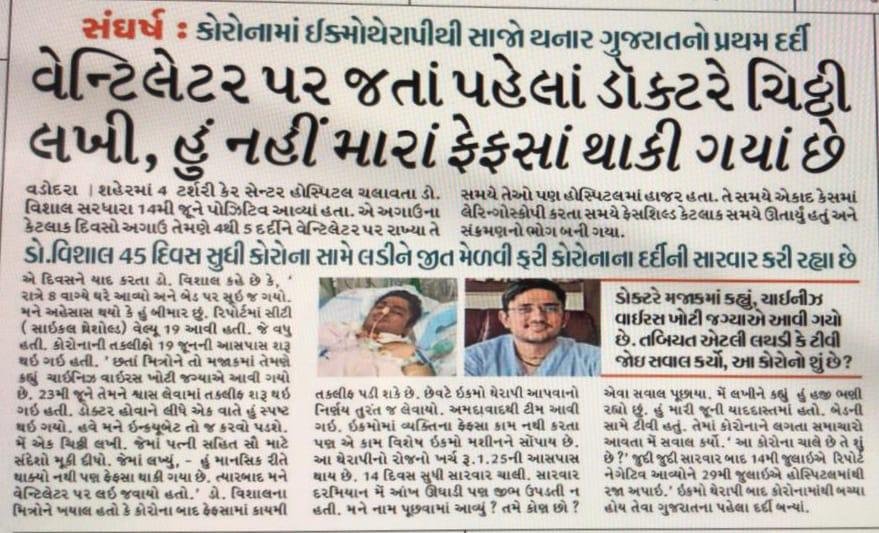
According to the newspaper report, Dr. Vishal Sardhara became Gujarat’s first patient to receive ECMO (Extracorporeal Membrane Oxygenation) support during the COVID-19 pandemic. During the coronavirus outbreak, his condition deteriorated severely after infection, and he developed critical respiratory failure.
The article states that despite oxygen therapy and ventilator support, his oxygen levels remained dangerously low. Due to the seriousness of the condition and failure of conventional treatment, doctors decided to initiate ECMO support as a life-saving measure.
Critical Condition and ECMO Support
As reported in the newspaper, ECMO was started when the patient’s lungs were unable to function adequately. ECMO is an advanced medical procedure that supports oxygenation by circulating blood outside the body and supplying oxygen externally.
The patient remained on ECMO and ventilator support under continuous ICU monitoring. Doctors closely observed vital parameters, oxygen levels, and overall response to treatment throughout this critical phase.
Gradual Improvement and Recovery
The newspaper article mentions that after several days of intensive care and ECMO support, the patient’s condition began to improve gradually. Oxygen levels stabilized, and lung function showed signs of recovery.
Following sustained improvement, doctors carefully removed ECMO support and later weaned the patient off ventilator assistance. The patient eventually recovered from the critical condition.
Medical Milestone Highlighted by Media
The report highlights that this case was a medical milestone in Gujarat, as ECMO treatment during the early phase of COVID-19 was rare and available only in limited centers. The successful recovery was acknowledged as a significant achievement in critical care management during the pandemic.
The newspaper coverage documents this case as an example of how advanced medical technology and timely intervention can save lives in severe COVID-19 cases.